SITE RATING:
7/10
SITE REVIEW:
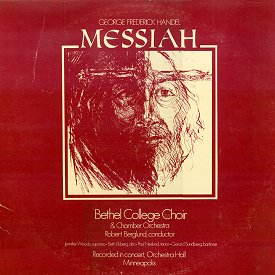
The Bethel College Choir and chamber orchestra, under the
direction of Robert Berglund, recorded this impressively smooth Messiah sometime in the early
1980s, and it's a telling document of the times. This was the
same year which Christopher Hogwood recorded his ground-breaking nouveau baroque Messiah, and, in the sleeve notes
to this recording, Robert Berglund notes the sea change that is taking
place in baroque performances of the time, particularly among chamber
orchestras, who, with their lighter, smaller forces, were injecting
swift new tempos into previously stately interpretations. Berglund
himself, who directed the Bethel College forces and taught there since
the late 1950s, was an advocate and practitioner of these slower tempi
for many years, but at the time of this recording, found himself caught
up in the "new-wave" of faster, lighter baroque enthusiasts. His Messiah races, the tempos bounding
along. The choir and orchestra are certainly up to the task of
following their conductor; among amateur forces, these are among the
tightest, smoothest-sounding performers I've ever heard; with crisp,
clean melismas, and admirable unity in tone. The soloists are
nearly up to their level, with only tenor Paul Neslund sounding
spread-vowelled and strident, but the rest, especially baritone Gerard
Sundberg and alto Beth Ekberg giving electrifying performances.
But there's a telling problem with this performance, and it's
directly tied to the "new" baroque movement - the tempos don't serve
the music; in many instances, the choruses and arias are fast, simply
for the sake of being fast - and the tempos draw constant attention to
themselves, when the attention should be on the power of the music and
the text. I often felt while listening that many colorful dynamic
opportunities were being lost, sacrificed on the altar of swiftness;
which made this recording interesting as a touchstone of the era, but
also a caution against following a trend for its own sake.
|